If you have ever watched a long-haul flight crossing the Atlantic or Pacific, you have been flying under a set of rules that did not exist fifty years ago. For most of the twentieth century, commercial twin-engine aircraft were not allowed to fly routes that would take them more than sixty minutes from the nearest suitable airport. That rule made long-distance twin-engine flying essentially impossible. Every transoceanic route required three or four engines, which meant bigger, more expensive aircraft and fewer viable city pairs.
The rule that changed everything is called ETOPS, which stands for Extended-range Twin-engine Operations. ETOPS is the reason most of the world's long-haul flights today are operated by twin-engine aircraft like the Boeing 777 and 787 or the Airbus A330 and A350. It is one of the quiet regulatory developments that reshaped global aviation, and understanding what it actually means makes every long flight make more sense.
The sixty-minute rule and why it existed
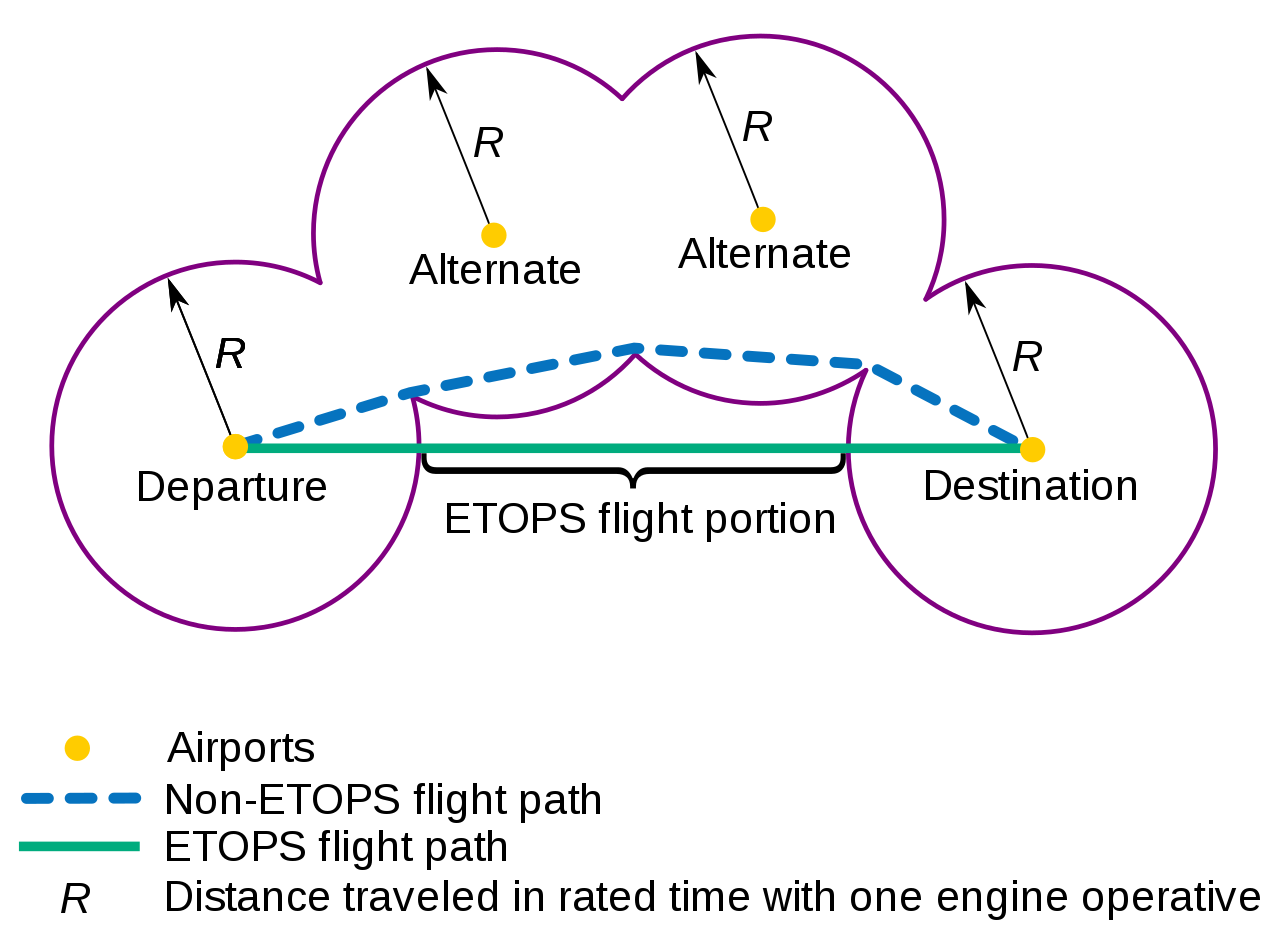
In the 1950s and 1960s, jet engine reliability was nothing like it is today. Engines failed often enough that aviation regulators wanted significant margins built into every flight plan. The sixty-minute rule required that any twin-engine aircraft operating commercial flights had to remain within sixty minutes of a suitable diversion airport at all times, flying on a single engine at normal cruise altitude. If an engine failed, the aircraft had to be able to reach an airport before anything else went wrong.
The rule was not unreasonable given the data at the time. Twin-engine aircraft were considered marginal for over-water flying, and the available engines had mean time between failures that would alarm a modern aviation engineer. Four-engine aircraft like the Boeing 707 and 747 were the default for long-haul. Three-engine widebodies like the DC-10 and L-1011 filled the gap between twin-engine short-haul and four-engine long-haul.
The commercial cost was enormous. Airlines had to operate larger, more expensive aircraft than they needed just to satisfy the diversion requirement. Ultra-long routes between continents were limited to airlines that could afford four-engine widebodies, which constrained competition and pushed up prices.
How ETOPS certification works
ETOPS is not a single rating. It is a tiered certification system where each tier allows the aircraft and operator to fly a specific maximum distance from a diversion airport, measured in minutes of single-engine flying time.
The progression began in 1985 with an initial 120-minute ETOPS certification, which allowed certified aircraft to fly up to 120 minutes from a diversion airport. This opened up North Atlantic routes for twin-engine aircraft for the first time.
A 180-minute certification followed, which made most transoceanic flying practical. A 207-minute variant allowed additional route flexibility. Later certifications reached 240 and 330 minutes, and in specific cases even 370 minutes. Each extension opened new routes that had previously been off-limits.
The certification is granted based on the aircraft type, the specific airline operator, and the specific engines installed. An airline cannot simply buy a Boeing 777 and start flying ETOPS routes. The airline's maintenance program, pilot training, and operational procedures all have to meet the specific ETOPS standard. The engines have to have proven reliability records, measured in in-flight shutdown events per million flight hours.
Why twin-engine flying is now safer than four-engine was
Modern ETOPS-certified twin-engine aircraft are, by every measurable standard, safer than the four-engine aircraft they replaced. The engines themselves have become dramatically more reliable. Mean time between in-flight shutdowns has improved by more than an order of magnitude since the 1970s. Redundancy within each engine has increased. Maintenance practices have evolved to catch problems before they cause failures.
The statistical basis for ETOPS approval is that a modern widebody twin has a lower probability of a dual engine failure at any point during a flight than a four-engine aircraft of the 1970s had during a typical long-haul cruise. The regulatory decision to allow twin-engine ocean crossings was not a relaxation of safety standards. It was a recognition that engine reliability had improved enough to make the previous rule excessively conservative.
What ETOPS means for specific routes
The 180-minute certification made trans-Pacific flying practical for twin-engine aircraft by allowing routes that cross the central Pacific, where diversion airports are widely spaced. Hawaii and Guam serve as mid-Pacific waypoints for flights between North America and Asia.
The 240-minute certification opened up polar routes, where the density of diversion airports is extremely low. Flights between North America and Asia that route over the Arctic depend on ETOPS-240 or higher certification to be legal.
The 330-minute and 370-minute certifications make possible routes that cross the Southern Ocean between Australia and South America, where diversion airports are essentially nonexistent across thousands of miles of open water.
The Boeing 777 was the first aircraft to be certified to 330 minutes. The 787 and A350 have followed. The Airbus A350-900ULR, used on Singapore Airlines' Newark flights, operates under 370-minute certification to handle the specific routing requirements of its ultra-long-haul missions.
The practical limits on ETOPS flying
ETOPS is not unlimited. The 370-minute certification is the current upper bound for commercial twin-engine flying, which means there are still regions of the planet where twin-engine commercial flights are not legal. Some routes across the Southern Ocean and some polar routes at certain times of year require four-engine aircraft even today.
The Antarctic region is almost entirely outside ETOPS coverage. Commercial flights that overfly Antarctica are rare and subject to specific waivers, typically requiring aircraft with three or four engines or specialized authorization.
Each flight plan is developed with specific diversion airports identified for every point along the route. If weather closes one of those airports, the flight plan changes or the flight is delayed or rerouted. Crews brief the diversion options before takeoff and monitor them throughout the flight. An ETOPS flight is not flying "somewhere within 330 minutes of land." It is flying with specific airports named and evaluated for every point in the cruise.
How to tell if you are on an ETOPS flight
Almost all long-haul twin-engine flying is ETOPS flying. If you are on a Boeing 777, 787, Airbus A330, A350, or 767 crossing an ocean or overflying a remote region, you are on an ETOPS flight. The ETOPS certification is transparent to passengers, because the point of the certification is to make the flight operationally identical to any other commercial flight. The only visible difference, if you know to look for it, is the specific routing chosen for the day, which is often optimized around ETOPS diversion airports.
Some routes that appear routine today would not have been possible at all under the sixty-minute rule. New York to Hong Kong, Los Angeles to Singapore, Toronto to Tokyo, Atlanta to Johannesburg: all of these are routine ETOPS operations that were impossible for twin-engine aircraft forty years ago.
The future of ETOPS
The current ETOPS ceiling of 370 minutes covers almost every commercial city pair in the world. Further extensions would open up the remaining edge cases, like direct routes over Antarctica or highly southerly routes between South America and Australia. These have been proposed but not widely adopted, partly because the commercial demand is limited and partly because engine reliability improvements are approaching their practical upper bounds.
The Boeing 777X, which is expected to enter service later in the 2020s, will likely be certified to at least 370 minutes and possibly higher. The A350-1000ULR, which Qantas will use for Project Sunrise flights from Sydney to London and New York, operates at the current ceiling.
ETOPS is one of those aviation topics that sounds like obscure regulatory trivia but actually explains the structure of the global air network. Every long-haul route you fly today is the product of specific engine reliability data, specific certification levels, and specific diversion airport availability. The shape of the global route map is not an accident. It is an engineering consequence of the rules that govern twin-engine over-water flying. The term ETOPS is the shorthand for all of it.


